


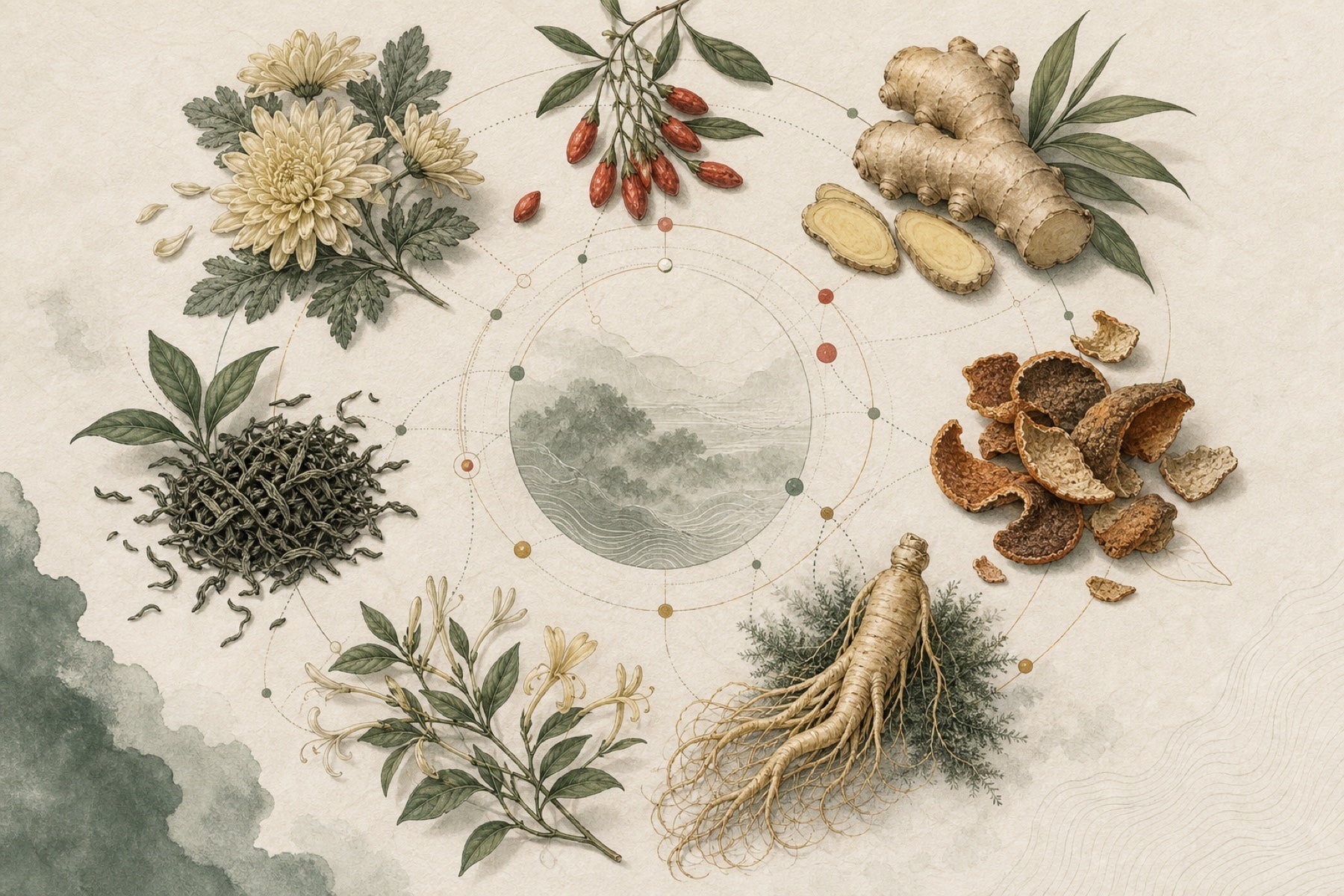
Herbs Are Not a List: Why Relationships Matter
Herbs are often presented as a list of promised benefits. That is simple to read—and too simple to be responsible.
A botanical has an identity, a plant part, an aroma, a flavour, a preparation history and a context of use. When two botanicals meet, their relationship cannot be understood by stacking two benefit lists together.
From catalogue to relationship
The 7eaminds Herbal Matrix is being developed as a living model rather than a fixed chart. It asks several questions at once:
- Do we know exactly which botanical and plant part we are discussing?
- How do aroma, bitterness, sweetness, colour and mouthfeel interact?
- Does the pairing make sense for a season, occasion or serving ritual?
- What safety notes, uncertainties or medication interactions must remain visible?
- What can careful user feedback teach us without turning experience into a medical claim?
This changes the role of the Matrix. It does not announce a “perfect” combination. It makes the reasoning behind a formula readable—and leaves room for the model to improve as evidence and experience grow.
A trustworthy knowledge system should show not only what it knows, but also where caution begins.
Herbal strength comes from coherence
In a thoughtful formula, botanical strength is not the loudness of a single ingredient. It is the coherence of the whole: character, proportion, preparation and purpose.
That is the connection we want to make visible: Herbal Matrix → Herbal Strength → Herbal Product. The product is the end of a chain of choices, not a shortcut around them.
Responsible-use note: herbs and botanical products may interact with medicines. People who are pregnant, managing a health condition or taking medication should seek qualified professional advice.
Explore the interactive Herbal Matrix →
Further reading: NCCIH — How herbs can interact with medicines.