


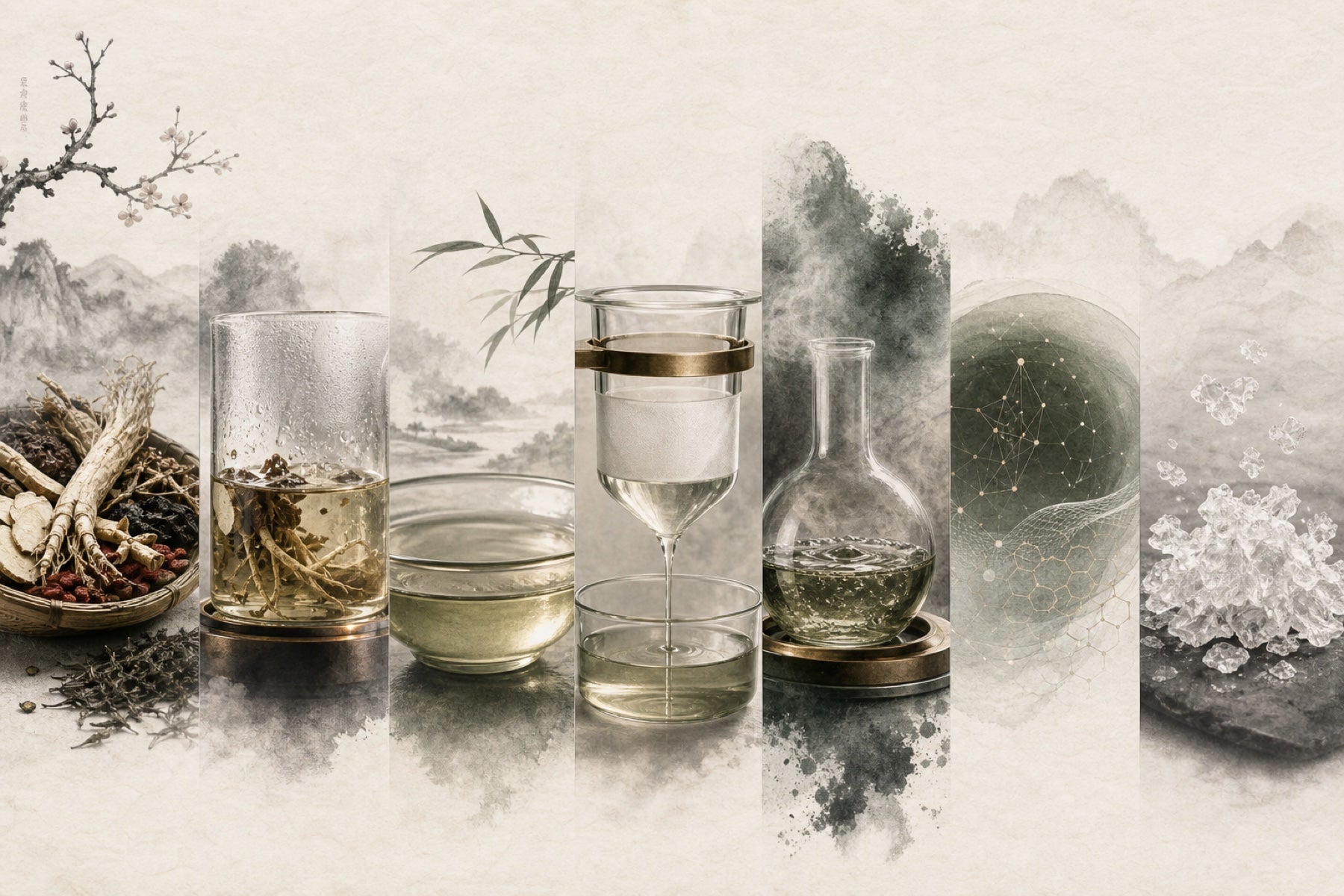
From Botanical to Soluble Crystal: Seven Decisions Behind a Modern Cup
A concentrated herbal tea is not simply ground herbs in a capsule, nor is it a tea bag made smaller. Before a soluble crystal reaches the cup, the botanical material has already travelled through a controlled process of extraction and concentration.
Seven decisions, one clear cup
At 7eaminds, we describe the process through seven stages:
- Material review — identity, condition and production suitability are checked.
- Controlled extraction — time, temperature and liquid flow are selected for the botanical formula.
- Cooling — the liquid is prepared for clarification and later handling.
- Filtration — suspended material is separated for a cleaner, more consistent cup.
- Concentration — water is reduced before drying.
- Food-safety controls — controls are applied for the product and manufacturing requirements.
- Freeze crystallisation — concentrated liquid is frozen and dried under vacuum to form porous, soluble flakes.
Each stage answers a different question: What material are we starting with? What do we want water to carry forward? What should be removed? How can the final portion disperse reliably?
Technology is valuable when it makes the character of a botanical more usable—not when it hides the botanical behind machinery.
Designed for contemporary service
The result is a pre-extracted format. Instead of asking a guest to steep and discard a tea bag, a measured portion dissolves directly into the chosen liquid. It is a small operational change with a larger implication: herbal tea can move more naturally into hospitality, travel and everyday routines.
What reaches the cup is therefore not the beginning of extraction. It is the final act of a process that began much earlier.